Using event wristbands to secure youth events
Managing a busy youth event requires tools that help your team identify attendees instantly and accurately. Event wristbands offer a highly visible way to confirm that a child belongs in a specific area or has permission to participate in certain activities. Unlike lanyards or loose badges, an event wristband stays securely attached to the wearer throughout the day. This physical attachment reduces the risk of lost identification and gives your staff a reliable focal point when checking access.
School administrators and youth organizers often need to implement security measures without relying on expensive electronic access control systems. A simple wristband system solves many common organizational challenges by giving volunteers a clear visual cue to follow. When your team issues event wristbands at the entrance, they establish an immediate baseline for safety and crowd management. This straightforward approach allows organizers to focus on the event itself rather than dealing with constant access confusion.
Matching children with groups and access zones
Organizers can use event wristbands to assign children to specific categories, helping volunteers maintain order across a large venue. A visible identifier ensures that staff know exactly where each child belongs and can quickly spot anyone who has wandered into the wrong location. This level of organizational clarity provides peace of mind for both the staff running the event and the parents attending it.
Class and age groups
Segmenting a large youth event by class or age group helps your team tailor activities and monitor appropriate behavior. You can assign a specific event wristband design to each age bracket, which allows volunteers to enforce age restrictions at a glance. When staff can instantly recognize a younger child in an area meant for older attendees, they can guide that child back to the correct location safely.
Designated activity areas
Complex events often feature restricted zones that require specific permissions or waivers for entry. Issuing event wristbands tied to designated activity areas helps prevent unauthorized children from accessing equipment or zones where they do not have clearance. Your volunteers only need to check the wristband at the entrance of the activity, reducing bottlenecks and keeping the lines moving efficiently.
Transport and bus matching
Coordinating transport at the end of a busy day is a high-stress moment for organizers. By matching wristband designs to specific bus routes or transport groups, your team can line up children quickly and accurately. Staff members can simply check the event wristband as each child boards, ensuring that no one gets on the wrong bus or leaves with an unapproved group.
Adding clear text and symbols beyond basic color coding
A successful event wristband system relies on foolproof identifiers that your volunteers can read in fast-paced environments. While assigning a specific background color to an access level is helpful, you should never rely on color coding as the only method for communicating critical access or safety information. Poor lighting, color blindness, and similar shades can cause staff to misread permissions and make costly access mistakes. To ensure accuracy, you must combine vibrant background colors with bold text, distinct symbols, or sequential numbering.
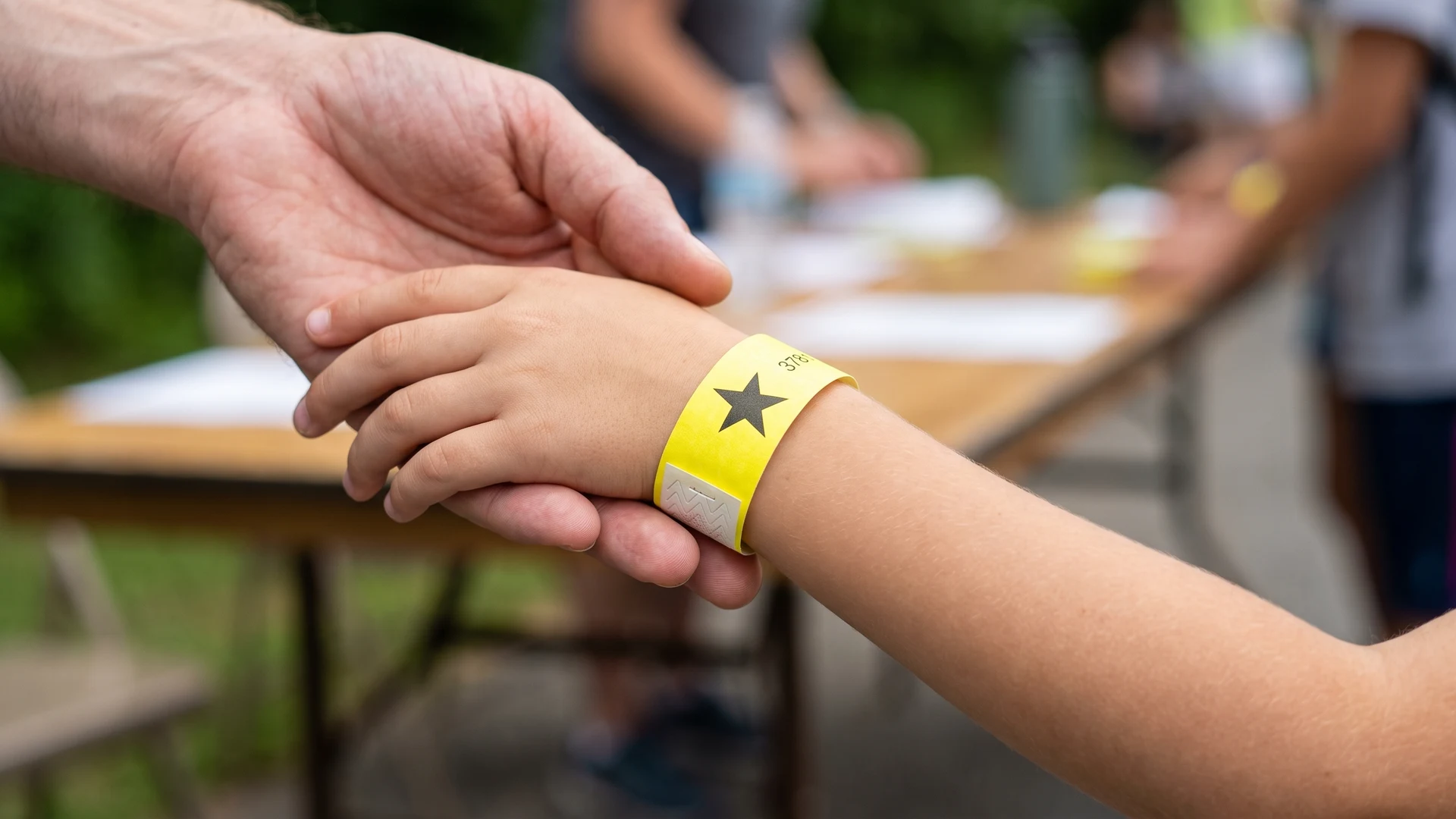
Printing clear text and symbols on the wristband gives your team an unmistakable visual cue to enforce rules. You can print the specific day, the activity name, or large alphanumeric characters that correspond to a child’s assigned group. Sequential numbering gives each wristband a unique number within a defined series, which helps your team track issued stock and connect a child to a specific registration record. These added layers of information turn a basic colored band into a highly functional security tool.
Running a consistent pick up procedure
Child hand-over to parents or guardians ranks among the most critical and high-stress moments for youth event organizers. Using event wristbands during the departure process provides a concrete workflow that your staff and volunteers can easily follow. Security relies on consistent human execution, so your team must follow a structured procedure to ensure every child leaves with an authorized adult.
- Establish a dedicated hand-over zone: Direct all parents and guardians to a single exit point where staff control the flow of departing attendees.
- Verify the parent credential: Ask the arriving adult to present their matching pick-up ticket, digital receipt, or corresponding parent credential.
- Inspect the child wristband: Have a volunteer check the child’s event wristband to ensure the printed details or sequential numbering matches the parent’s credential perfectly.
- Document the departure: Record the unique number from the child’s wristband on a checkout sheet or digital device to maintain a clear log of who has left the venue.
- Remove the wristband securely: Cut the event wristband off the child before they leave the premises so it cannot be found and reused by another person.
Choosing practical materials and secure closures
Selecting the correct physical material and closure ensures that the event wristband performs reliably for the duration of your gathering. You need to balance the length of the event with the required level of security, avoiding options that are either too fragile or unnecessarily complex. Understanding the specific properties of different materials helps you choose a solution that fits your exact operational needs.
Single day disposable options
For events lasting only one or two days, synthetic paper wristbands offer a lightweight and highly durable solution. Tyvek wristbands are made from a nonwoven material consisting of high-density polyethylene (HDPE) fibers, which gives them exceptional tensile strength and resistance to tearing. Because this material does not absorb water, sweat or rain will not weaken the wristband structure during an active outdoor school day. The microporous structure also remains breathable and comfortable against a child’s skin throughout the event.
Multi day durable materials
When an event spans multiple days, synthetic paper materials can begin to degrade, making woven or satin polyester fabric a better choice. Fabric wristbands are designed to withstand continuous exposure to water, heavy sweat, and constant friction over five to fourteen days of continuous wear. Unlike stiffer paper options, the soft and flexible fabric remains comfortable for extended use without causing irritation. These durable fabric wristbands also offer a premium look that attendees often keep as a souvenir long after the event ends.
Closures that reveal removal attempts
The closure mechanism dictates how effectively the wristband resists unauthorized transfer between users. Tyvek wristbands utilize a destructive face stock combined with security die-cuts in the adhesive flap. If someone attempts to peel the adhesive bond apart, the weak points tear the surface fibers into an irreversible fringe, immediately exposing the tampering. Fabric wristbands rely on plastic locking slides, such as barrel locks, which feature internal teeth in a one-way ratchet design. When pulled backward, these sharp teeth bite deeply into the woven polyester threads, meaning the lock cannot be loosened and the wristband must be cut off to be removed.
Preparing volunteers for visual checks
Even the most secure event wristband system only succeeds if your staff and volunteers understand how to inspect the bands properly. You must brief your team on exactly what to look for, including the correct colors, printed symbols, and signs of tampering near the closure. When volunteers follow a well-understood and consistently applied human process, they can confidently enforce rules and keep the venue secure. A physical tool requires proper operational workflows to be fully effective, so clear staff instructions remain your strongest security asset.
What is the most practical wristband for a one-day school event?
For a single day, a Tyvek event wristband is usually the simplest secure choice. Tyvek is a tough synthetic paper made from high density polyethylene fibers, so it resists tearing and water. Its single-use adhesive with security slits shows tampering. Checks stay fast and visual for staff.
How should we print wristbands to match children with the right group and manage pickup?
Print the group name, a short code, and a clear icon in large, high contrast text. Add the event date and a pickup code that staff can match to a roster. Avoid full names in public areas. A unique sequential number helps track stock and record replacements.
How can staff and volunteers check wristbands quickly?
Teach a fast three-point check. First, confirm colour plus printed text or icon matches the group. Second, inspect the closure for shredding or lifted edges that indicate tampering. Third, match the printed number or code to the list. Use a simple script so everyone applies it consistently.
What should we use for multi-day camps to prevent transfer?
For multi-day camps, choose a fabric event wristband with a plastic locking slide. The one-way teeth grip the weave and cannot be loosened, so removal requires cutting. Fabric stays comfortable through water and sweat, while adhesive synthetic paper bands can weaken after repeated days of wear.
How do we replace a lost or damaged wristband without weakening security?
Use a controlled replacement process. Verify identity with a roster or pickup contact, record the reason, and mark the old wristband number as void. Issue a new wristband with a fresh number, date, and initials. Note the time and staff member in the log.